The Single Malt Lagavulin Mein Favorit
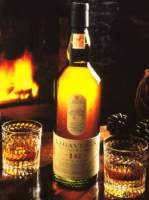
LAGAVULIN
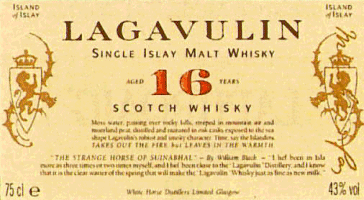
Location :Port Ellen, Islay (West Coast), Argyll. Strathclyde Region.Region :Islay, ArgyllCountry :ScotlandType : Islay MaltDistillery <../stills/index.htm> : LAGAVULIN DISTILLERY Port Ellen, Islay, Argyll PA42 7DZ Phone: +44 01496-302400/250 Fax: +44 01496-302321 Visitor Centre: 01496-302217 (+44 01496-302250) Founded :Est. 1816Owner :United DistillersProducer : White Horse Distillers Ltd.Water :Solan Hill's lake.Remark :(A Classic Malts of Scotland <../clasmalt.htm>) - Also used to "White Horse <../whithors/index.htm>" blends. A 16 year old distinctive and powerful Islay malt. It is deeply smoky and peaty with a velvety, complex finish. From the book : Malt Whisky - A contemporary Guide - By Mr. Graham Moore : In the twelfth century, Islay became the domain of the Lords of the Isles and saw the foundation of the clan Macdonald. The clan seat, Dunyvaig Castle, stands sentinel over Lagavulin Bay and it was from here in 1314 that over 1.000 Islay warriors embarked to fight for Robert the Bruce at Bannockburn. By the mid-eighteenth century illicit distilling was well established on Islay. Farmers saw it as a useful sideline and for some, such as crofters and fishermen, it was the only living available when winter came. By the 1740 there were ten stills on Lagavulin Bay. These gave way to two fully fledged distilleries which had combined by 1837 to form the basis of the Lagavulin that the visitor sees today. The name comes from the Gaelic - Lag A' Mhuilin - , meaning 'mill in the hollow'. Its history is inextricably entwined with that of its near neighbour Laphroaig <../laphroai/index.htm> and on occasions the fivalry has been far from friendly, resulting in more that one court case. Lagavulin was jointly owned by the Graham family and James Logan Mackie & Co, a partner in which was Peter Mackie who went on to build the Craigellachie <../craigell.htm> Distillery and establish the White Horse <../whithors/index.htm> brand. As an experiment Mackie set up the Malt Mill Distillery in 1908 within Lagavulin itself, and aim being to recreate old traditional working methods. The kiln had a haircloth floor and was heated by open chauffers fired entirely with peat. Malt Mill had its own washbacks but shared Lagavulin's mash tun, and heather was added to the mash (Mackie believed this to be the original practice). The two pear-shaped stills were the same as those at Laphroaig <../laphroai/index.htm>. Mackie even poached Laphroaig <../laphroai/index.htm>'s brewer to work on his new venture. However, if he was secretly trying to duplicate Laphroaig <../laphroai/index.htm>'s product (Lagavulin lost the agency for Laphroaig <../laphroai/index.htm> in 1907) the experiment was a failure. Mackie's family line ended in 1917 when his son James was killed outside Jerusalem, but Malt Mill survived until 1962, its maltings now converted into Lagavulin's visitor centre. In 1924 the company commissioned a small coaster to transport barley, coal and empty casks from Glasgow to Lagavulin and deliver the whisky to the mainland. The SS Pibroch (a pibroch is a phrasem usually a lament, played on the bagpipes) remained in service for almost 30 years and also served Caol Ila <../caol_ila/index.htm> and Talisker <../talisker/index.htm> distilleries. On two separate occasions in 1937 the little puffer was called upon to rescue crewmen from Fleetwood trawlers which had run aground, earning her the nickname 'the Fleetwood lifeboat'. Inset into a wall of the distillery building is a gravestone. It was intended as a headstone for the grave of a local man, buried on the nearby island of Texa. The stone never mad it to the island however, as when it was being loaded onto the boat a chain snapped, and the superstitious boatman took this as an omen and refused to make the crossing. The distillery has remained a memorial to him ever since. Lagavulin is virtually a statement of the Islay character and many factors are held to be influential on the spirit, from the larch washbacks to the particularly steep angle of the lyne arms atop the still. Peter Mackie attributed its flavour to the burns which supply the distillery's water and which fall over almost 100 waterfalls on their way down the peat-covered slopes of Beinn Sholum. It is pungent and assertive and, at 16 years old, quite a good age for a standard bottling. Time, as it says on the label, takes out the fire but leaves in the warmth.
Textblock